

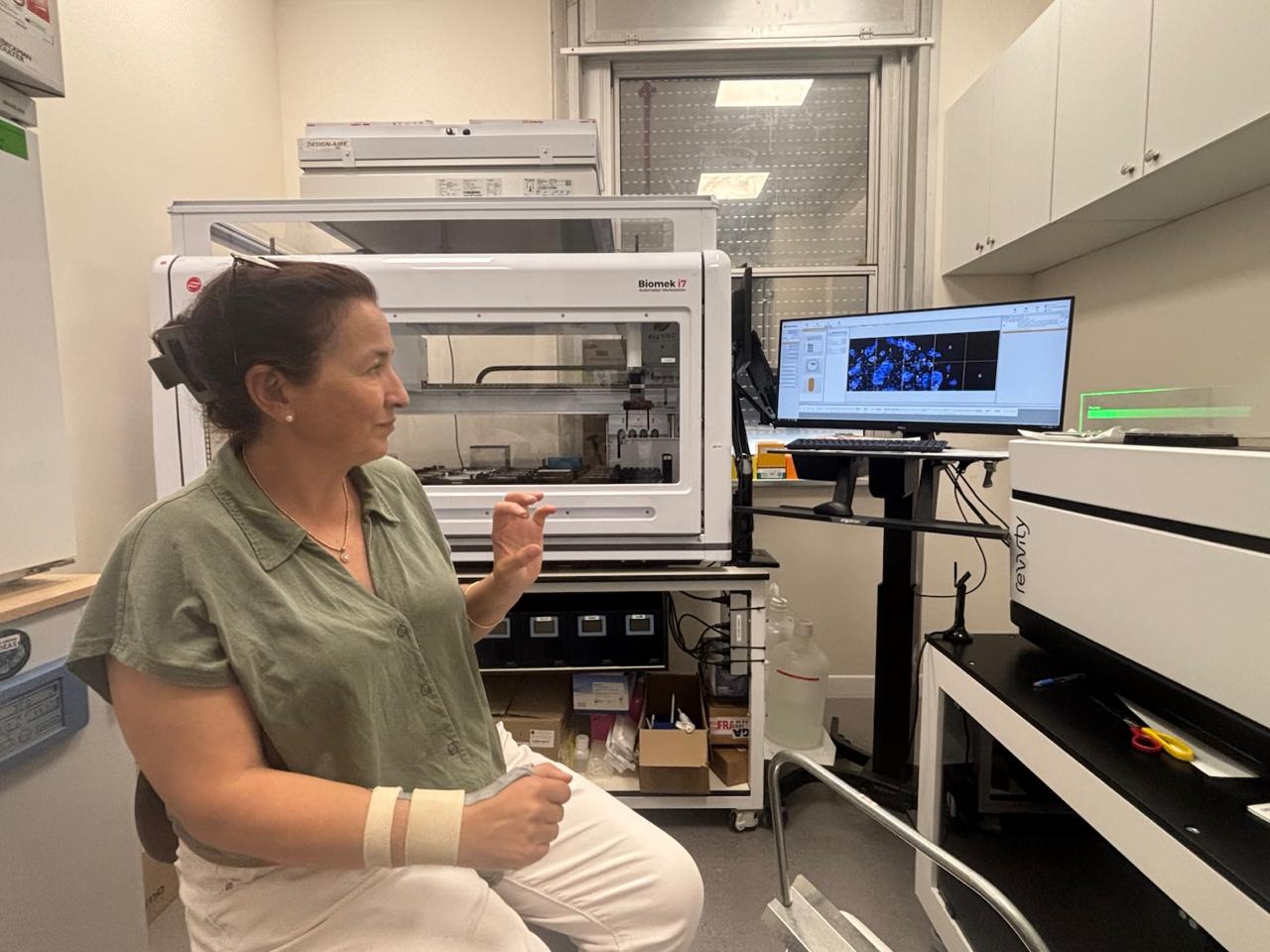
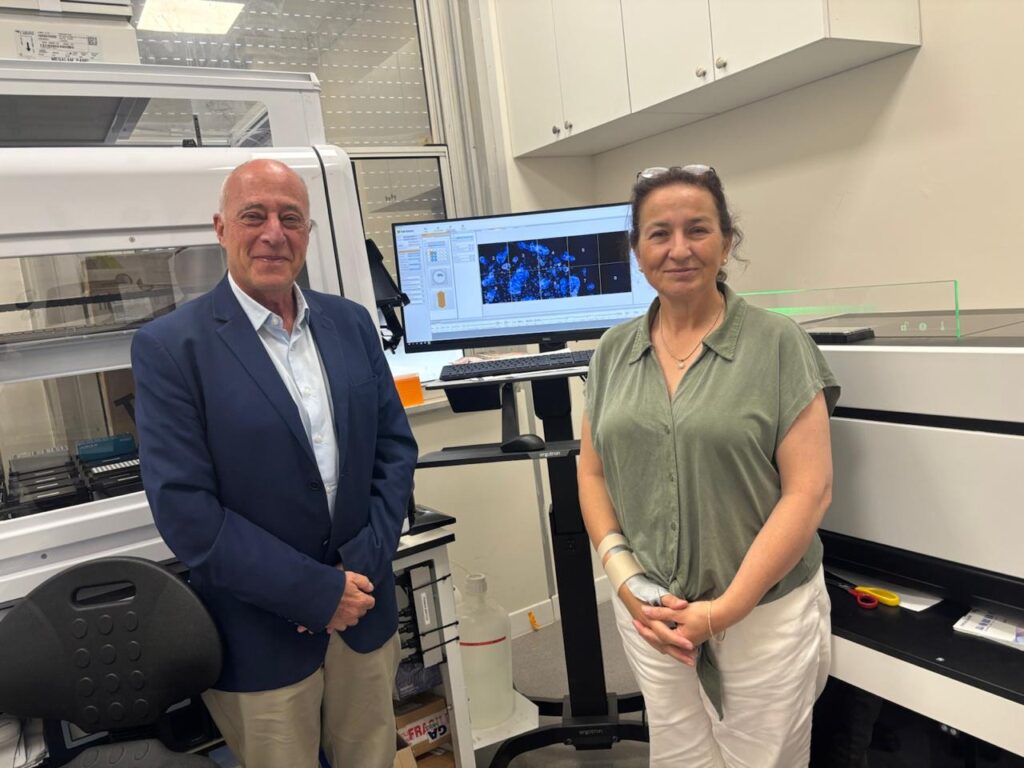
Itongadol (By Daniel Berliner, from Israel).- Biologist Myriam Grunewald is the director of the Organoid Research Center at Hadassah Hospital and welcomed Itongadol to her laboratory to discuss this scientific innovation that is revolutionizing the world.
The specialist explained the use of organoids to test drugs, their application in personalized medicine, the response they could provide to cancer treatments, and their use as transplants to treat diseased tissue.
— When was the Center founded?
— I founded it together with a pediatric gastroenterologist (Liron Birimberg-Schwartz, who is the medical director), in October 2020. I teach and conduct research at the Faculty of Medicine, and Professor (Eyal) Mishani, who is the head of Hadassah’s Research and Development Division, identified that organoid technology existed and told us that we should bring it to Israel, since until we founded the center, this technology was only used in certain specific places. So, he recruited us, we studied the subject, and we began working.
— What is an «organoid»?
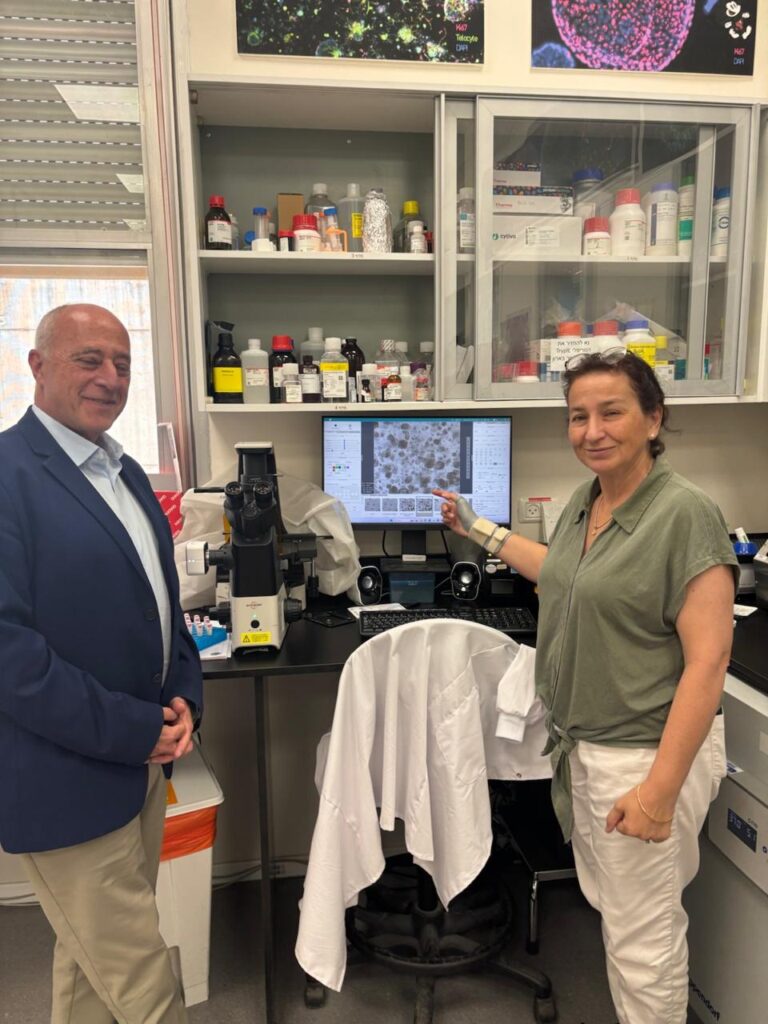
— It starts with a biopsy; that is, a piece of tissue that we take from someone undergoing surgery or a procedure. They come in for an endoscopy and a sample can be taken through the tube. We receive it, break it down to obtain a soup of cells, clean them, and then the magic consists of placing those cells in a gel so that they can be organized in three dimensions. To that we add a medium; that is, a substance that provides them with everything they need to feed, drink, everything… They have everything necessary to grow, divide, differentiate, and function as if they were inside the body. These small balls can be placed under a very expensive and advanced microscope, where we examine them.
— How did it all begin?
— We had seen in the scientific literature that more and more people were using organoids for various purposes, both for basic science and personalized medicine, and we are very interested in personalized medicine. We had also seen that the FDA (the acronym in English for the Food and Drug Administration), which is the United States government agency that decides whether a drug can be administered to patients or not, determined, based on results, that laboratories needed to incorporate a more suitable model than the mice or cells we were using. They asked the scientific community to create a new model that more closely resembled what happens in human tissues because, if we put it in numbers: of the 250 drugs that we test in the laboratory with the classic, old models, only one of them ultimately produces the same effect in humans. So those figures made the FDA say: «Enough, something new needs to be created,» and it was necessary to wait until 2009, when there were two very important publications from the laboratory of (molecular geneticist and biologist) Hans Clevers in Utrecht, the Netherlands, which simply demonstrated that it was possible to take mouse tissues and grow them in such a way that the authenticity of the tissue was preserved. The tissue that grew in the culture plate was very, very similar to the tissue observed in the human body…
— And what happened during these five years?
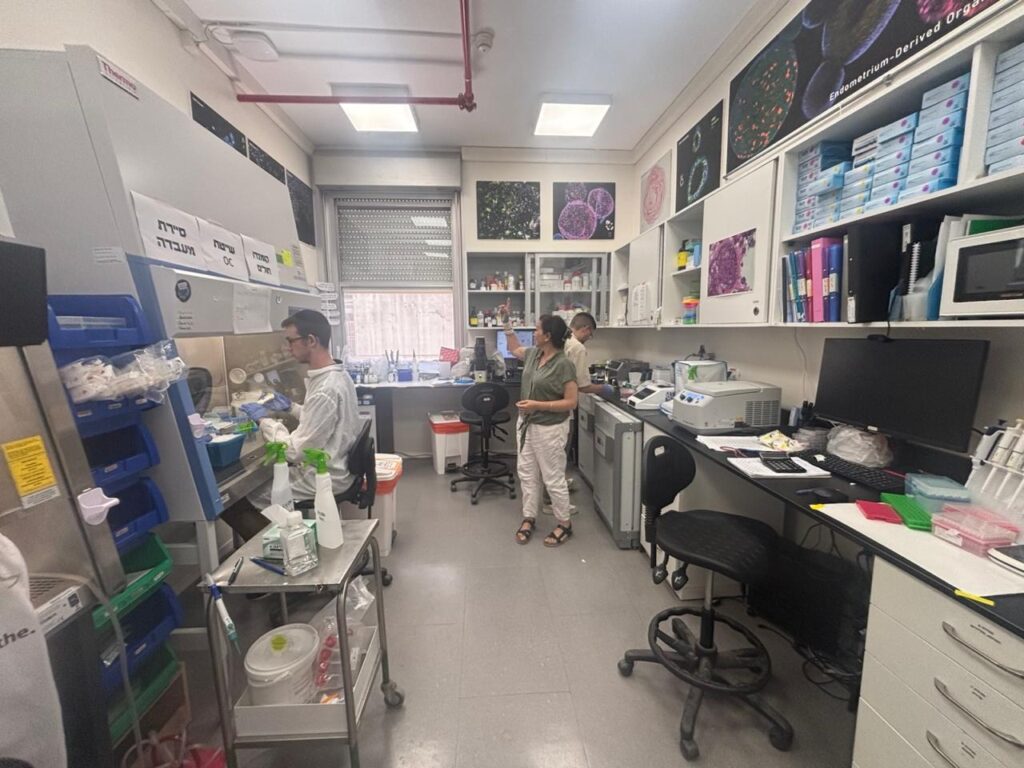
— We started in a very small room downstairs, where my office is now, with a small culture room. There were three of us and, in fact, we started by obtaining the necessary approvals. Since this involves human material, we needed approval from the Hadassah Ethics Committee and the Israeli Ministry of Health. That took time, but we explained everything to them… Then we learned the method. Liron, who works with me, knew how to do it, but only at a basic level, so together with Deborah (Durán), who was with us at the beginning, we took protocols from the scientific literature, started testing them, and saw that they worked, although not completely. So, we took the published protocols and improved them… Then I began giving lectures on the subject to all the departments at Hadassah, in order to interest doctors, because for this to work we needed a physician to work with us and tell us that there was an interesting patient from whom it would be worthwhile to create organoids to test drugs… I also gave lectures at the faculty, to interest researchers and tell them: «Look, we have a new, very powerful tool. You should use it.» I went to other hospitals, universities… I gave a lecture at the Weizmann Institute, and in all kinds of places, to generate interest… And in fact, little by little, we built a community. For example, at the hospital we have WhatsApp groups in which there is always a doctor, whether an oncologist, gastroenterologist, or pulmonologist; a pathologist, to whom we bring the piece of organ we obtained, who examines it and, from there, adapts the study that the patient will sign, because they have to authorize us to do what we do; and someone responsible for that particular disease. Now, in our biobank (a bank of biological samples and clinical data for biomedical research), we have more than 500 patients from whom we have created organoids, both from diseased tissue and healthy tissue, which allows us to do many things…
— Before, all patients received the same treatment. Could that be different now?
— Exactly. That is what is called «personalized medicine»… Now we have a very interesting project in which we analyse their genetics, what mutations they have. We analyse pathology results, what tests were performed… We analyse many pieces of data: their age, where they come from, how many children they have, all of that… We are starting a breast cancer project in collaboration with Professor Shai Rosenberg (head of the Computational Medicine Service). He is a genius, also a mathematician and computer scientist. Incredible… I received funding and recruited him so that we can take patients, perform genomic analysis —meaning which mutations, epidemiology, all those things we know about the patient—, in addition to the oncologist’s opinion, Shani Paluch. We will also create organoids and see how they react. With all of that together, in the end we will be able to predict what is most appropriate for Mr. Cohen, and not for Mr. Levy. This is what is called «personalized medicine»… That every time there is a patient, there will be medications that we know will work… If you have a headache, you take an aspirin. That works for everyone… But for chemotherapy or other medications, we need to carry out procedures like this…
— If each person has a different treatment, where will the money come from?
— An example: someone arrives with a tumor that can be removed. In other words, the surgeon can go in and remove it, but asks to reduce it beforehand because that way the patient will have a better outcome. So, they give the patient chemotherapy and tell them to come back in a month, hoping that the tumor will have shrunk. We know that this will not work in one out of every two cases. That is, out of two patients, it will work for one of them, who will return and we will be able to operate on them, while the other will return and the tumor, in the best-case scenario, will not have changed, or in the worst-case scenario, will have grown, metastasized, and surgery will no longer be possible. So, that is a situation in which we need to create organoids: take the patient’s tumor, test chemotherapy, and tell the oncologist: “Don’t give it to them, it won’t work. Try something else, because if you give it to them, they will come back in a month and have a larger tumor”… Or, for example, when someone arrives with cancer and there are many options… Today there is so much research that there are many drugs that can be given. Which one should we choose? So, you study that type of cancer, what subtype it is… But sometimes the oncologist still has options. Which one should they choose? And if you want to test it directly on the patient, that has side effects… I think the issue of money… Yes, it costs money, but it makes it more effective. In other words, you will be more certain about what you are giving the patient… For example, one could say that if this continues moving in this direction, within five years it will be possible to do this in every hospital. So, when there is uncertainty about what to administer, an organoid can be created…
— Are there things you know are good for a certain type of cancer or that work generally for everyone?
— Precisely now, what we are doing, and what the whole world is doing, is trying to see how similar what we do with organoids is to what happens in a human being. This is what is called a “clinical trial.” We take patients and their organoids and compare the response to treatment. For example, in the case of Malena (Cohen-Cymberknoh, director of Hadassah’s Pediatric Pulmonology Unit), we know that it works for cystic fibrosis. Why? We take a colon biopsy from patients with cystic fibrosis and create organoids from it. The protein affected in cystic fibrosis is expressed in those organoids, and we add the drug. It is a very, very simple trial because the culture swells when water is added if the drug corrected the condition.
— The whole world is talking about and watching what is happening with cancer. Are you also involved in that?
— First and foremost, we have research that demonstrates that what we obtain in a culture is truly very similar to what we obtain in a patient. There was even a case in which, regarding a patient, we recommended to the oncologist that she receive additional chemotherapy, besides the radiotherapy she was already receiving, because we saw in the cultures that this was what was needed. She received it and, thank God, she has not had a recurrence… But this is something small; now we want to do it on a large scale…
— Is this the present or is it already the future?
— Yes, it is the future, absolutely… And I have not even mentioned that organoids can be taken and transplanted… Taking healthy organoids and treating diseased tissue… They are already doing this in Japan, for the intestine… We are doing it for the uterus, experimentally for now, but that is where we are heading… The future is now. It is happening now, and this field is advancing at a very rapid pace. The technologies are also developing… I think: how do you recognize that a field is going to succeed? When there are other technologies that accompany it… So, there is technology that allows us to do much more with organoids, there is AI (artificial intelligence), which is entering this field very strongly… In our project to predict the best drug, AI intervenes in the organoid cultures, in how to identify them, and in all kinds of technical aspects… So, these three things —microscopy technology, organoids, and AI— go together… In the United States, only in 2025 did they open a center, with a budget of 85 million dollars, like the one we opened in 2020. In other words, they identified that organoids are the future…
— What is happening in the world in this regard?
— The world is moving in this direction… The FDA is requesting organoids. There is already the first drug developed based on organoids. There is still a lot of work to do with animals and other areas, and there is a center that was founded to improve these technologies.
— And where is Israel positioned?
— At Hadassah, we will soon travel to the United States to give a course, in August. We will teach students about organoids: how to create them, how to use them, and all of that… I am taking the entire laboratory: we are going there, teaching for a month, and then returning home. It will be at the MBL, in Boston. It is the Marine Biological Laboratory, a very beautiful and prestigious place… We are very happy… There is a young man who came from Peru and wants to establish an organoid center in a hospital in Peru, so he asked us how we could help them and, of course, we are willing to teach them… Our center is a biobank; that is, we create organoids to distribute them. We conduct our research and also provide services to companies that want to test drugs or researchers who want to test a mechanism, but we also teach, and I really like that. We are a knowledge center to teach others.
— When you arrive home and go to sleep, are you aware of what is happening in your life?
— I have been in science for many years, so I know that many times you research, research, research, and nothing comes out. But there are moments like this, when you feel that you have done something to improve patients’ lives and you have achieved it. In other words, I have really worked my whole life in basic research —I research aging, blood vessels, and the heart— and this is the first time I have the feeling that I can truly help someone specifically, and another person, and another one.
My goal, my ambition, is that we can do this for as many people as possible, to truly reduce suffering and optimize treatment, and we are achieving it. Someone said that in five years there will be no more cancer because we will know everything. In my opinion, all technologies are moving in the right direction…
— Changing the subject completely, there was a war in Israel and, from what we can see, you continued working all the time…
— I thought about this a lot at home because I saw… They would tell us: “There will be missiles for another five hours, we have Iran and all that,” so people would say: “Well, what do we do?” And then we would watch a movie, go to sleep… In other words, we kept going… “We have a safe room, a shelter, so we go to the shelter…” And the same thing happened at work… I think the Jewish people… In this laboratory we also have non-Jews… Those of us who live in Israel have resilience, we have the ability to deal with any situation, so we said: “Well, not everyone will be in the laboratory at the same time; we will work in shifts,” but we continued… And in the streets of Israel, you can see that not everyone is afraid; people live their lives… There is a force of life that is stronger than everything else…
— Is that a response or is it your way of life?
— I don’t know where it comes from… I hear a lot about what is happening in France because I have family there and they say: “In the difficult times we are living through, nothing can be done,” people are depressed and all that… Come on! What is happening to them is that there is a small increase in prices… I remember that when we were there with the kids, we turned on the television and heard: “Attack in a supermarket,” so we said: “What? Here too?” And what had the attack been? Chicken had gone up by one euro… That was the terrorism there… So, I say: I don’t know if it is good that we can be so flexible as to deal with any situation, but we continue with all our strength.