

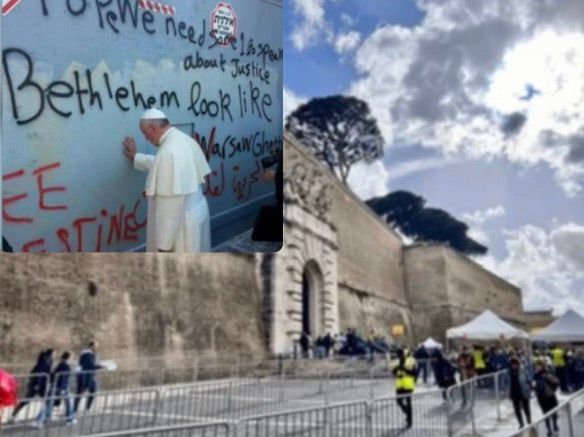
Two walls, one double standard. One protected the Vatican from an Islamic army — The other protects Israeli civilians from Islamic terrorism
Itongadol/Agencia AJN (Leon J. Halac).- Pope Francis broke the line of the 4 popes who preceded him. Pope Leo XIV appears to be
following suit.
I. A Forehead Against the Wall
May 2014. Bethlehem. Pope Francis steps out of his vehicle, approaches the Israeli security
barrier, and presses his forehead against the concrete. He says nothing. He doesn’t need to. The
image travels around the world within hours.
«Suddenly I saw the wall, and the idea came to me: ‘Why don’t I stop and pray here?’ And he
began to pray,» explained Msgr. Carlos Aguiar Retes, President of CELAM, in statements to
ACI Prensa on May 27 in Rome.
What almost no media outlet noted was that the very same wall was covered in graffiti equating
Israel with the South African apartheid regime and with the Warsaw Ghetto. One read in English:
«Bethlehem look like Warsaw Ghetto.» Another: «Free Palestine.»
Pope Francis did not speak, but he let the wall speak for him. Words fade with the wind; the image
of Israel compared to the Nazis who exterminated his own people endures with painful weight in
our memory.
Francis, however, lived — and his successor still lives — behind walls that have a name and a
date: the Leonine Walls, built between 848 and 852 by Pope Leo IV (coincidentally, the current
Pope is named Leo XIV), after the Saracen sack of St. Peter’s Basilica in 846 A.D. This was no
architectural whim. It was the response to a real and documented threat: a fleet that sailed up the
Tiber, exposed the papacy’s inability to protect its own symbols, and compelled the construction of what still stands today.
It is hard not to notice the irony: the same papacy that asks the world to build bridges instead of walls has spent more than eleven centuries living behind its own.
II. The Sophistry of Bridges
«Build bridges, not walls.» A phrase Francis repeated across many stages and contexts. It sounds
moral. It sounds Christian. The problem is that, like any metaphor turned into policy, it collapses
when confronted with reality: build bridges toward whom? Who will be standing on the other side?
The Israeli security barrier — which Francis chose as the backdrop for his gesture — was not built out of a desire for exclusion. It was built following the Second Intifada (2000–2005), when suicide bombings on buses, in markets and restaurants killed more than one thousand Israeli civilians in just a few years. After its construction, attacks fell by more than ninety percent. That is not an ideological figure — it is a fact.
The parallel with Leo IV is exact. In the 9th century, the seat of the papacy was left exposed
because it had no walls. In the 21st century, Israeli cities were left exposed because they had no barrier. Both walls protected lives. The difference is that one draws tourist admiration, and the other draws a Pope’s forehead in protest.
The question that no one asked in Bethlehem is simple: who is being asked to tear down their walls first? And from what moral authority does one ask, when the person asking lives behind their own?
III. Acted Messages
Francis was a communicator of precision. His most effective messages were not spoken: they
were performed. And in those performances, a consistent line revealed itself.
The nativity scene gifted by the Palestinian Authority, displayed with pontifical approval, depicted the infant Jesus wrapped in a Palestinian keffiyeh. The message operates on two levels. The first: the erasure of Jesus’s Jewishness — a Jewish man from first-century Bethlehem, in Roman Judea, recast as a symbol of 20th-century Arab nationalism. The second: the implicit legitimization of a narrative that displaces any Jewish historical continuity in the Holy Land. This is not a minor theological error. It is a deliberate inversion of history.
His inquiry to the newspaper La Stampa about whether genocide was occurring in Gaza is another
example of the same architecture. Francis did not assert — he asked. But in doing so, he inserted
the word into public debate with implicit papal endorsement, while assuming no direct responsibility. It is a well-known rhetorical technique: asking what cannot be stated outright.
And a media technique: dropping a bomb that will run as a front-page headline, later denied in a small box on an inside page, while the concept of «Israel the genocide state» takes root in public consciousness.

genocide»
This was not a novelty — it was continuity. In 2024, ten years after the 2014 image alongside the
word Auschwitz.
What the not-so-innocent papal question omitted, ignored, or preferred not to see: the only
documented attempt at genocide during that period was the October 7th assault in the Negev. With
recorded orders. With explicit declarations by the perpetrators. With a methodology that the killers themselves filmed. That generated no journalistic inquiry from the Vatican.
IV. Tell Me Who You Walk With
The Document on Human Fraternity, signed in Abu Dhabi in 2019 alongside Grand Imam Ahmed
Al-Tayyeb of Al-Azhar, was presented as a landmark of interreligious dialogue. Abu Dhabi and its
rulers deserve that recognition: they are a genuine example of openness and coexistence among
traditions.
But the problem was not the place. It was the interlocutor.
Al-Tayyeb has welcomed figures linked to terrorism at Al-Azhar. He has systematically denied the
historical bond between Judaism and Jerusalem — one of the most thoroughly documented
connections in ancient history. He represents an institution that has never produced its own Nostra
Aetate, its own rupture with centuries of theological hostility toward the Jewish people.
«Tell me who you walk with, and I will tell you who you are.» The choice of Al-Tayyeb as privileged interlocutor was not a mistake by Francis. It was a revelation. Two figures sharing the same underlying worldview: the Arab-Israeli conflict read as colonial oppression, humanitarian rhetoric as cover for political positioning, narrative over fact.
Francis broke the line of the four popes who preceded him. That line had deep roots: philosopher
Jacques Maritain and Jewish historian Jules Isaac advanced it from the Seelisberg Conference of
1947; Cardinal Agostino Bea implemented it institutionally at the Council; John XXIII turned it into a conciliar process; Paul VI closed it with Nostra Aetate; John Paul II recognized the Jewish people as elder brothers in faith; and Benedict XVI consolidated it theologically. Nostra Aetate, endorsed by more than two thousand bishops, was a conscious institutional break with centuries of replacement theology. It was not a personal decision — it was a decision of the Church.
Francis reversed that direction. Without a council. Without consultation. With gestures.
V. Leo XIV and the Crossroads
The 2025 conclave elected Cardinal Robert Prevost, who took the name Leo XIV. Those who know
him say he will follow his predecessor’s example. The early months of his pontificate confirm that reading: he declared a Palestinian state to be «the only solution» to the conflict, noting that «Israel still does not accept it.»
The formulation ignores a fundamental asymmetry: the rejection does not come from the Israeli
side alone. It comes from an organization that has educated entire generations toward the
non-recognition of Israel, and whose founding Charter has never been revoked. When asked what
place Jews would have in that Palestinian state, Hamas’s historical answer has been consistent:
they will be driven into the sea.
And in its founding Charter: «The time will not come until Muslims will fight the Jews and kill them; until the Jew hides behind rocks and trees, which will cry: O Muslim! There is a Jew hiding behind me, come on and kill him!»
In his first Christmas sermon, Leo XIV denounced the conditions of Palestinians in Gaza in an
unusually direct appeal during what is normally a solemn and spiritual service. He said that the
story of Jesus born in a stable showed that God had «planted his fragile tent» among the people of the world.
Who are «the people of the world»? The Palestinian Jesus?
Who are not «the people of the world»? The Jewish Jesus?
Leo XIV used the birth of Jesus in Bethlehem as a metaphor for solidarity with the Palestinians of Gaza. But Jesus was not born among «the people of the world» in the abstract. He was born in
Bethlehem of Judea. Into a Jewish family. In the context of the Roman Empire’s census — an
empire occupying the land of the Jewish people. His name was Yeshua. His mother’s name was
Miriam. They went to the Temple in Jerusalem to fulfill the precepts of the Torah.
The «people of the world» with whom God «planted his fragile tent» were Jewish. To use that birth to speak about Gaza without mentioning that context is not merely a historical error. It is precisely what Francis’s Palestinian nativity scene did: erase the Jewishness of Jesus in order to turn him into a contemporary political symbol.
The circle closes painfully. Francis did it with gestures — the nativity scene, the wall, La Stampa.
Leo XIV does it with words — at Christmas, before the world, in the most watched sermon of the
year. The method changed. The direction is the same:
Contrary to the path of the 4 preceding popes.
Contrary to the Second Vatican Council.
Contrary to the encyclical Nostra Aetate.
This has consequences that extend far beyond Israel. A Vatican that erases the Jewishness of
Jesus, that equates self-defense with aggression, that chooses as its privileged interlocutors those who deny history, does not only damage Israel or the Jewish people. It damages its own credibility as a moral institution — and with it, Christianity’s capacity to speak with authority to the universal conscience.
This continuity is not accidental. Francis did not only set an ideological course: he prepared the institutional ground for that course to continue. It is speculated that Prevost was his preferred candidate, and that his prior transfer to the United States was part of that positioning. The conclave did not choose change. It chose consolidation.
VI. An Invitation
This article is not a condemnation. It is, at its core, an invitation.
The papacy has a history of building real bridges. John XXIII did so with the Second Vatican
Council and Nostra Aetate. It was not a personal gesture: it was an institutional process, backed by thousands of bishops, that acknowledged a historical debt and opened a door that had been shut for centuries.
Leo XIV can choose that direction. He can build bridges toward historical truth, toward the people who gave birth to Christianity itself, toward a reading of the Middle East conflict that does not sacrifice complexity on the altar of narrative. He can do so from Abu Dhabi — which genuinely deserves that framework — but with interlocutors who have demonstrated reciprocity, not with those who exploit the prestige of others to legitimize denial.
There is also a precise theological compass for that direction. In July 2018, already retired from the pontificate and under no institutional obligation, Joseph Ratzinger published in the journal Communio a twenty-two page article titled «Grace and Vocation Without Remorse: Notes on the Treatise De Iudaeis.» It was not a papal declaration. It was a theologian who continued thinkinghonestly about the relationship between the Church and the Jewish people.
His conclusions are unequivocal:
The Church did not replace Israel in God’s plan; God’s gifts and calling to the Jewish people
are irrevocable; and in the creation of the State of Israel «God’s faithfulness to Israel is
revealed, in a mysterious way.»
Ratzinger proposed replacing the theology of substitution with a theology of complementation: two
peoples as distinct witnesses to the same God, not as competitors. Francis ignored that path. Leo
XIV can reclaim it.
The Vatican has walls. It needed them. It still needs them. Israel needed them too. And still does.
Building bridges is a virtue. But before asking others to tear down their own, one ought to look at one’s own. And before choosing with whom to build them, it is worth remembering the proverb that
Francis — a man of popular culture, a man of Buenos Aires — surely knew better than anyone:
«Tell me who you walk with, and I will tell you who you are.»