


Itongadol.- The Maccabees coined a phrase that has become part of Jewish life, especially for those connected to sports and Maccabi community institutions: Hazak Ve’ematz! In Argentina, FACCMA is one of the organizations politically affiliated with Maccabi World Union.
At this very moment, some 300 people —leaders, athletes and professionals— are packing their bags to take part in a historic event in the State of Israel: the 2026 Maccabiah Games.
In this interview with Esteban Bluvol, president of FACCMA, we see what Jewish leadership is made of after October 7. He appears strengthened and convinced that transmitting Jewish identity to younger generations is now more essential than ever. Sports and informal Jewish education, he believes, are the guarantee of the future.
This is an insightful conversation with a man who has become a true leader for these challenging times, and whose answers contain many of the responses so many of us are searching for.
– How are you experiencing this period leading up to the Maccabiah in Israel?
– You can feel the adrenaline. It’s something that runs through your veins and makes you want to be involved in every detail of every athlete’s journey. On Sunday we held a farewell event for all the athletes —the 270 participants who will be traveling— together with their parents and children. It is a tremendous responsibility for us, but we are increasingly committed and firm in our decision to move forward when others are not. We know how important the State of Israel is, and sometimes that must be demonstrated through actions, not words.
– Why adrenaline?
– Because we have been planning this for more than two years. Because last year it was postponed due to the war. Because this year we didn’t know what was going to happen. And when it was finally confirmed that we were moving forward, we worked very hard to first understand the situation ourselves, together with our partners in Israel, and then explain it to every athlete, every parent, every spouse, every child and grandchild. We had to convey why it was so important to go to Israel for a Maccabiah that will be different from any previous one. There had never been an October 7. There had never been a war with Iran. The level of antisemitism around the world was not what it is today. Showing up now is a matter of humanity, Zionism, belonging and commitment.
That is exactly what we have been doing — convincing people one by one. And when I say one by one, I mean one by one: parent by parent, meeting by meeting, Zoom call by Zoom call. “This athlete wants to go but his mother doesn’t — let’s call the mother. The mother wants him to go but the father doesn’t — let’s call the father. Someone still has doubts — let’s call him”.
That is what our team has been doing over the past 45 days. Fortunately, many people trust us. Many others do not, or are afraid, and that is completely understandable. Fear is personal. These decisions are personal. Those who go are not heroes, and those who stay are not cowards. Fortunately, 270 people will be traveling, and we are only a month away.
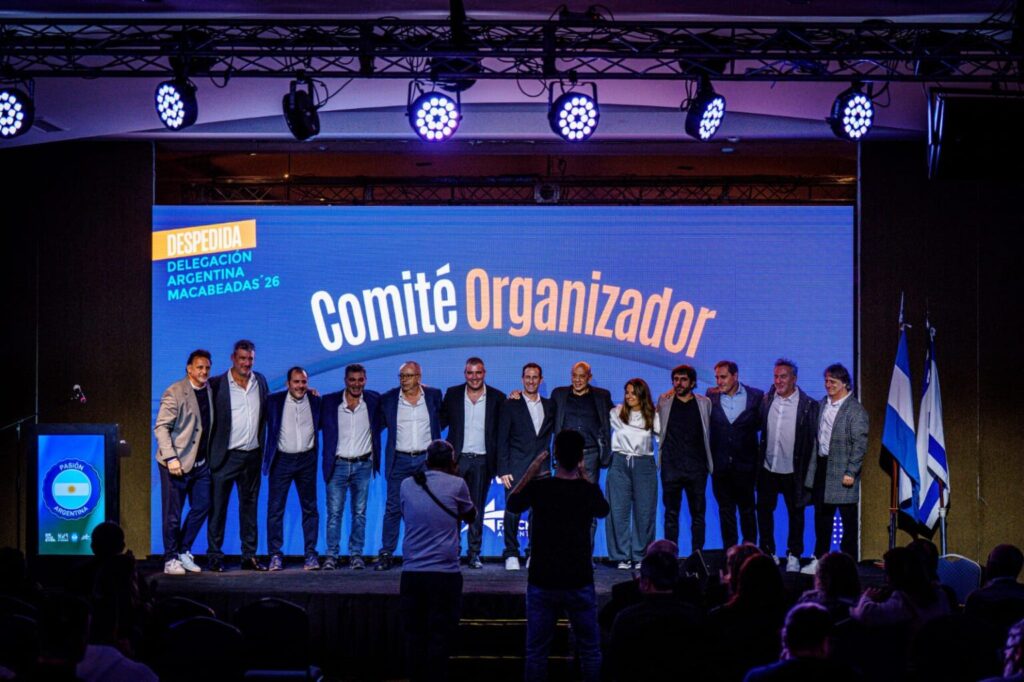
– I’ve been observing the kind of leader you have become, and it’s very different from the leader who first took office. War changes people. Leaders evolve, but I think the war brought about a deeper transformation. Not every Jewish leader speaks with such certainty and confidence. There was a photograph from Sunday’s farewell event showing the people who work alongside you. I imagine they are the first ones learning from you and preparing for the day when you may no longer be president and they will carry the responsibility. What defines the new kind of leader today?
– Today a leader must know how to work as part of a team. A leader must know how to build a team made up of people with different strengths: people with more patience, people with less patience, people who speak Hebrew well, others who speak English well, people who understand sports, people who do not, people who understand content and know how to ensure that a delegation does more than just train, that it visits the Holocaust Museum, experiences a Shabbat, participates in a Passover Seder. These are all things I learned over the years.
You saw a photo with 13 or 14 people working on this project, but there’s another interesting number: we have spent 160 hours in meetings over the past two years. That’s not an exaggeration — it’s true. People ask, “What can these people possibly discuss for 160 hours?”. Well, we built this Maccabiah delegation five or six different times. At one point we had a delegation of 550 people, then we reduced it, then rebuilt it. Some sports teams were later canceled. Some participants withdrew because they were afraid. Others were added. We continued making adjustments right up until this week.
And why? Because I believe the first people you must convince are your own team. Some members of my team were afraid. Some had spouses telling them, “Where are you going? Stay here’’. I told everyone: “Look, if you are not completely convinced, there is no problem. You can step off the ship for this Maccabiah. We organize six events a year, we run leagues every weekend, there is plenty of work at FACCMA. But I do not want anyone going against their will or creating conflict at home. That is not what this is about.”
I gave them one day. “We’ll meet tomorrow. Whoever shows up is fully committed. Whoever doesn’t show up should not worry — there will be no consequences and nobody will lose their position”. The next day, everyone was there. First, we had spoken with our executive director, who expressed concern that some members of the team were uncertain. Yet the next day they all came. And I asked them again: “If you are sitting at this table, I want you to be convinced, because we do not have a crystal ball”.
Can you guarantee that nothing will happen during the Maccabiah? No, I cannot. What I can guarantee is that if something does happen, we will be prepared to protect you, your child and every member of the delegation. That is what we have prepared for.
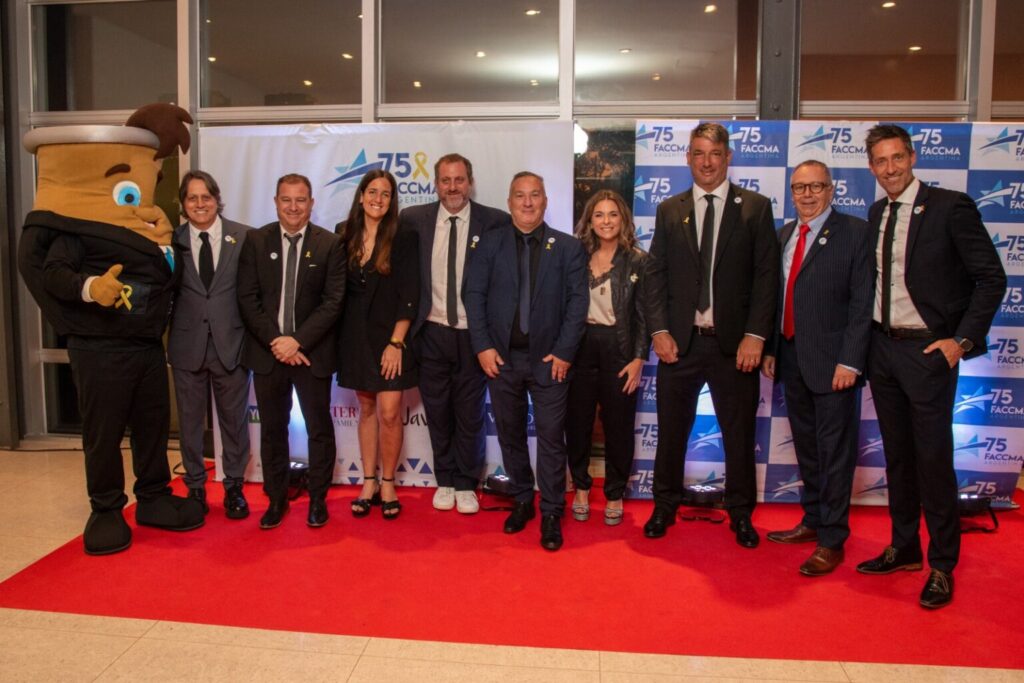
– FACCMA is responsible for a significant part of Jewish communal life outside the formal educational system. Many families turn to it as an alternative space for Jewish engagement. What changed after October 7? What happened to the institution, its leaders and its affiliated organizations?
– October 7 changed Jewish communal life in Argentina and around the world. Some people became more Jewish and more Zionist. Others chose to hide, to withdraw. We had an event scheduled at Hacoaj on October 20, 2023. Normally about 1,000 children attend. It was our “Escuelitas” event, for children aged six to ten. Only 480 children came — less than half.
When I spoke with Hacoaj President Osvaldo Ofman, we both agreed: “We’re holding it even if only 100 children show up”. Because what terrorism ultimately seeks is to stop you from doing things. That is its real victory. It uses violence and weapons, but its victory is achieved when you stop attending Shabbat, stop celebrating Passover, stop participating in Jewish communal life because you are afraid. After that event we said: “We were right to hold it. We are not going to stop doing anything.”
We organized the Pan American Games in December 2023 with 2,000 international participants. Some countries, like Canada, chose not to attend. At that point all of us became more committed leaders. We devoted more hours because the effort required to accomplish the same objectives had tripled. We had to overcome fear. Every year we organize the Bekeff trip for graduating students. That year it was canceled. The following year it was canceled again because of the Houthi attacks. Instead, we held it in San Juan.
Then, last year, after the 12-day war with Iran, we took 350 teenagers to Israel. Many mothers told us we were crazy, that we were taking their children into a war zone. Yet on January 7 we ended up singing Hatikvah at the Western Wall together with the ambassador, while parents stood there in tears. So what is informal Jewish education today? It is a vital complement to formal education, which faces enormous challenges. Our community is changing because of intermarriage, assimilation, antisemitism and fear.
We must be convinced of what we are doing. Every young person we educate, every young person we take to Israel — whether through Bekeff, the Maccabiah or any other program — returns transformed in ways that cannot be replicated elsewhere. Why do we insist so strongly on the Maccabiah? Because a teenager who plays for Hacoaj, Cissab, Hebraica, Círculo, Macabi or Lamroth Hakol will put on an Argentine jersey with his surname on the back and compete against an Israeli athlete.
He will want to ask him: “What are you doing here playing soccer? Can I give you a hug?”. And the Israeli athlete may say: “Thank you for coming,” to the first major international event organized by Israel after October 7. That is the significance of this event.
Today every Israeli national team effectively has to play away from home. Many people do not want to come to Israel. Yet we will be arriving from 25 or 30 different countries to show up and stand together. Under normal circumstances, the Maccabiah attracts 70 countries and 7,000 international participants. This year there will be around 30 countries and 2,000 international participants. But every one of those 2,000 people will be remembered. Hopefully, by the next Maccabiah, we will no longer be talking about war. Hopefully we will bring 600 participants in a climate of peace, and that will be normal. What is not normal is going now.
– I’m seeing a different kind of leader today. What happened to you personally? Was this already in your DNA and you knew it from the first day you took office because those who chose you knew it too? Or did you have a foundation but mature, unfortunately, because of a tragedy like the one we experienced? Did you discover something within yourself that you didn’t know you had—or that you did know you had?
– I don’t know, honestly, I don’t know. What I can say is that I’ve changed, and I try to help others change as well. Today I lead a team, and as a leader, I couldn’t do this if I were pretending. No one could. I’m convinced of what I’m doing, and every day I try to convince everyone else as well—professionals, volunteers, doctors, members of the press, parents, athletes. I think the circumstances I faced after October 7—the war with Iran, antisemitism, and everything else—made me much stronger and more resilient. Maybe there was something deep inside me that I didn’t know existed. I didn’t grow up in Jewish sports clubs. I went to a Jewish school and came from a normal family, but today I am completely committed to being a promoter of Zionism and Judaism wherever I may be.
– What is the message? What is the secret you could share with many people?
– I think our Latin DNA is bolder and more rebellious. If a rule needs to be broken, we break it. The English, French, or Canadian mindset tends to be much more about following instructions. If another leader came to me today and said, “You don’t need to take people there”, I would be very upset. We have to recognize that we have a pro-Israel government and that Jewish life in Argentina is free. In many other countries, that simply isn’t the case.
What I can say is that sometimes, when there are too many rules and everyone follows them, progress becomes very difficult. When I talk to leaders from other countries, I sometimes feel they are focused on details while not paying attention to whether people are proudly wearing their names on their jerseys. The world has changed and is still changing. Europe is not a safe place for Jews, despite its large Jewish population.
The Jewish communal life we have in Argentina—schools, synagogues, clubs, events—is remarkable. Someone told me yesterday that Limud organizes an Urban Rosh Hashanah celebration in a public square. That would be unthinkable in London, Paris, and even in some parts of the United States. We never really appreciated that because it was always there. I have colleagues who had to remove the mezuzah from their doors. In France, Jewish children who don’t attend Jewish schools are often harassed, so they have no choice but to attend Jewish schools. Here, many of our children attend public universities and live openly as Jews. We only began to value these freedoms when we realized that others didn’t have them. Before that, it all seemed normal.
– Since you’re already thinking about future generations, I always remember when Belinky and Slafer chose Waldo Wolff, who was very young at the time. They were older men. And now you, who are still young, are already thinking about what comes next.
– I believe leaders have a responsibility to ensure continuity within the community, continuity among work teams, and the development of new leaders. Otherwise, politics takes over: one administration leaves, another arrives, and suddenly everything the previous one did is considered bad.
I believe in continuity. I continued many of the excellent initiatives that Mónica Sucari started. Of course, I added my own style, and of course I had to deal with October 7 and war, circumstances that didn’t exist before. Others faced the pandemic; others faced nothing extraordinary. If we want professional organizations and strong teams, then the good things must continue through successors and future leadership teams. If we don’t think that way, we’re making a huge mistake, and our institutions will continue producing leaders we complain about without doing anything to improve them.
– After this stage in your career, would you consider becoming president of DAIA?
– No, I’m not ready. I won’t say never. But I’ve always been someone who likes to work and get things done. Throughout my professional life, I’ve focused on building teams, and that’s what I do best. I’ll probably continue being involved in the next administration, but in a different role.
Today I’m very connected internationally—with Israel, the United States, and other countries. I’m always paying attention to what’s happening elsewhere, such as Canada deciding not to participate in the Maccabiah. Sometimes one leader says, “We’re not going,” and then nobody goes.
– Guiora organized a Maccabiah in Germany, in Berlin…
– And I was there. It was the best Maccabiah in history, in 2015. We marched right next to the place where, in 1936, Hitler would not allow Black athletes onto the podium.
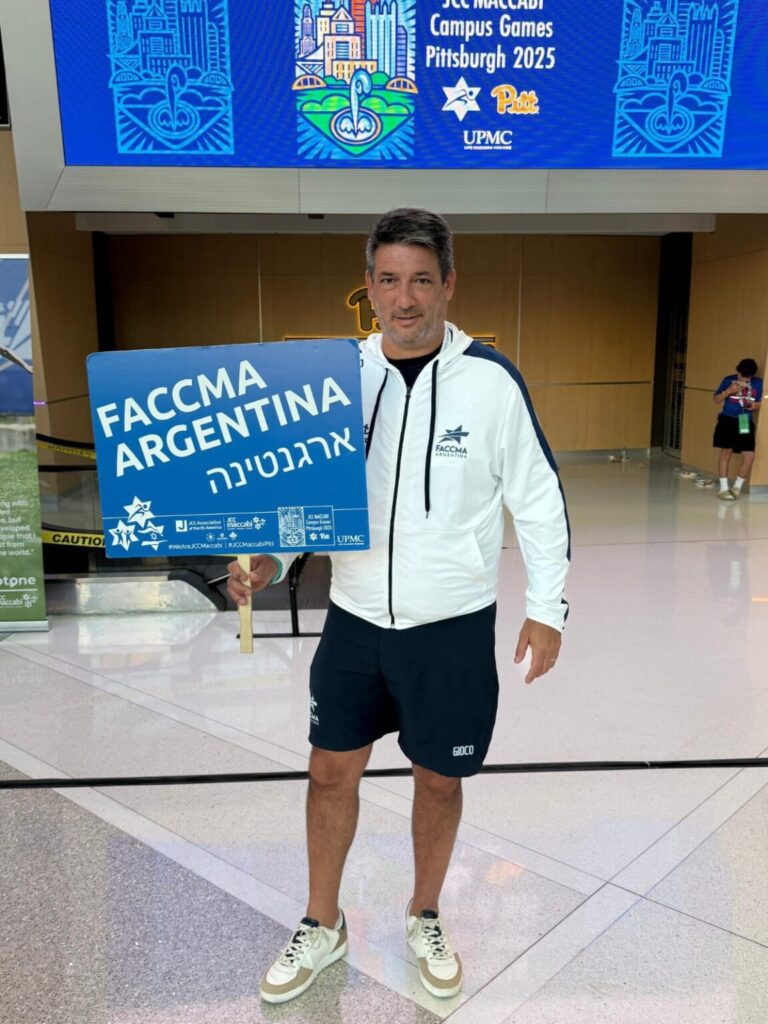
– You ended your speech by saying “Jazak Veematz”. Is that something that is constantly present in your mind?
– Today I think we honor the Maccabees, who gave us our name, during a difficult period. Every day we pray that the situation remains stable, that it doesn’t escalate, and that the airport stays open. We dream about one specific moment: July 1, at Teddy Stadium in Jerusalem, marching and singing Hatikvah alongside 30,000 Jews from around the world. After that, whether you win or lose won’t really matter.
– President Milei’s visit to the Arena was surprising and impactful. How did you experience it?
– It was extremely challenging because we weren’t prepared for that level of protocol. We had ten chairs. When Milei arrived, we couldn’t have five chairs on one side and four on the other, so we had to add another one. Then his security team needed seating behind him, and suddenly there was a dispute over which ministers would sit in the front row and which would sit in the second row.
We had the Israeli ambassador to Argentina, who was arguably the most important guest. We had the U.S. ambassador, Mark Stanley. We had the president of Maccabi World Union and the president of the Olympic Committee. We ended up moving some of them to the rows behind.
The funniest part—which I’m not sure everyone knows—was when the Argentine delegation was marching and Javier Milei turned to Karina Milei and said, “Why am I not marching?” Karina replied, “Because you’re standing here wearing a tie.” I always joke that our delegation marches wearing Le Coq apparel, and I told the president of Le Coq that if we had put a jacket on Milei and let him march, making the front page of every newspaper, he would have owed me free clothing for life.
– But the fact that he is someone who values Maccabean history and attended that event, it feels different from the past.
– We should value that and take advantage of it. There are always people who say, “Maybe he shouldn’t support us so much.” I disagree. Just as we once had leaders who signed a memorandum with Iran, today we have a government that openly supports Israel.
Despite two terrorist attacks and many challenges, the Jewish community remains vibrant and active. We have the only Jewish soccer league in the world where 70 matches are played every weekend. We should use this moment to leave behind lasting achievements for future governments—decrees, laws, and educational initiatives. Education is the most important thing.
If we can educate non-Jews with the truth, it will be a major step forward. Today, social media, trolls, disinformation campaigns, and paid influencers spread misinformation that sticks. Once falsehoods take hold, our ability to defend ourselves is limited. That’s how I see it.
– How many people are traveling, and when do they leave?
– The event lasts two weeks. It begins on June 30 and ends on July 14. We are bringing 270 participants, of whom approximately 215 to 220 are athletes. The rest are coaches, assistants, delegates, doctors, media personnel, staff members, and directors.
The advance team—those of us arriving five days early to prepare—will leave on June 22 and 23. The athletes will depart between June 28 and 29. The return trips begin on July 14. The opening ceremony is on July 1, and the closing ceremony is on July 13.
– One word you keep returning to is antisemitism. FACCMA has a broad perspective. How do you view the issue as a leader after October 7? What is the challenge facing the Jewish world moving forward?
– Unfortunately, October 7 generated far more antisemitism than we expected. We were invaded, attacked, murdered, and burned alive. Yet the sympathy for that situation disappeared very quickly.
Soon, the focus shifted to Gaza, and the Gaza narrative began dominating headlines. Even when later evidence showed that certain incidents had been misrepresented, it was already too late—the damage had been done.
I believe the greatest challenge is education. We need to educate people in general. We need to teach what happened on October 7 and include it in public-school education. When antisemitic incidents occur in sports—between one of our teams and another team—I’d say that 90% of the young people making those comments don’t really know what they’re talking about. They heard it at home or saw it on Twitter, TikTok, or Instagram.
Then they visit the Holocaust Museum and realize they know nothing because nobody taught them. Nobody told them. You learned about it in school and perhaps heard family stories from grandparents or great-grandparents who lived through it. Many young people today don’t have that connection.
As time passes and survivors are no longer with us, if these stories are not taught, nobody will know them. That’s why the great challenge is education, training, and preparation for a future that will be even more complex than what we have already experienced.
– I attended a farewell event for Ambassador Eyal with prosecutors and judges. I was struck by how all the prosecutors thanked him, saying there is no place for antisemitism in Argentina because of the actions of the justice system. They argue that antisemitism will not take root here because they are doing the necessary work, with support from Israel. Is that a valid assessment?
– It’s very significant. The fact that people can file complaints and that those complaints are actually acted upon, because the judiciary treats antisemitism as a crime, an offense, or a legal violation, is extremely important. It demonstrates the seriousness of the judicial branch, which we know has not always functioned this way.
I hope this moment lasts. And if it doesn’t, then we should at least use it to ensure that some of these advances remain in place for the future.
– Is there anything else you would like to add regarding the trip?
– We are very proud of what we are doing. Now the departure is very close, our adrenaline is running high, and we can’t wait for July 1 to arrive. We hope people will follow everything through FACCMA’s social media channels and through ItonGadol, where we will be sharing everything that happens there.